Coaching for newly promoted managers and first-time leaders, built on a method where the people you lead decide whether you have changed. It also works the other way round from most coaching. I select the leaders I take on, because this only produces results with people who genuinely want to change, and I would rather tell you that at the start than take your money and find out later.
45 minutes, free, and it runs both ways. You find out how I work. I find out whether coaching would actually help you.
You were the strongest individual contributor on the team. That is why you were promoted, and it is exactly the skill set that stops working on your first day in the job. Most new managers are handed a title, a team, and no instruction.
Delegating feels slower than doing it, so you do it. Your team learns to wait for you, and your evenings disappear.
The friendship and the authority pull in opposite directions, and nobody has told you which one to put down.
Underperformance goes unnamed for months. By the time you raise it, it has become a bigger problem than it needed to be.
Your team will not tell you what they think of your leadership, and your manager is watching outcomes rather than behaviour.
Developed by Marshall Goldsmith in 1987 and used with senior leaders in some of the world's largest organisations. It rests on one idea that sets it apart from most coaching: the people you work with decide whether you have changed, and they are involved in the change rather than observing it.
Not a list of twelve. A focused 360 assessment gathers how the people around you actually experience your leadership, and from that you pick the smallest number of changes that would make the biggest difference to them.
You go to your direct reports, peers and manager, name the behaviour out loud, and ask for their help. This is the step most leaders want to skip, and it is the step that makes the rest work. Announcing it converts private intention into public commitment.
Feedback relitigates the past, which people are reluctant to give honestly and leaders are reluctant to hear. Feedforward asks a different question: what are two things I could do differently next month? It is easier to give, easier to receive, and it is actionable.
The work happens in your actual meetings with your actual team, not in the coaching room. Our sessions are for planning the next experiment and reviewing the last one.
A brief, structured monthly conversation with each stakeholder. This is the engine of the method and the single variable the research found separates leaders who improve from leaders who do not.
At the close, the same stakeholders rate whether your leadership effectiveness has changed. Their verdict is the result. Mine does not count, and neither does yours.
Marshall Goldsmith built his practice on tying the coach's fee to measurable improvement as judged by the leader's colleagues rather than by the coach. I work the same way, and the two halves of that are connected. I can carry the risk of the fee only because I am selective about who I take on. A coach who accepts everyone cannot make this promise and mean it.
Goldsmith and Howard Morgan studied leadership development across eight major corporations and published the results in Strategy+Business. The finding that matters for you is uncomfortable and useful: attending the programme changed very little. Following up with colleagues changed almost everything.
Leaders who discussed their own improvement priorities with coworkers, and then followed up regularly, showed striking improvement. Leaders who did not follow up improved no more than by chance.
Finding from Leadership Is a Contact Sport: The “Follow-up Factor” in Management Development, Marshall Goldsmith and Howard Morgan, Strategy+Business. Summarised here; read the original for the full method.
The effect appeared whether leaders had an external coach, an internal coach, or no coach at all. What mattered was the follow-up.
Goldsmith has spent close to forty years coaching senior executives, and has been recognised by Thinkers50 as the world's most influential leadership thinker twice, and as the world's leading executive coach for over a decade.
His argument is that the behaviours which make someone successful early in a career are frequently the ones that limit them later, and that changing those behaviours is not an insight problem. Leaders usually know what to do. The difficulty is doing it consistently in front of the people who already have a fixed picture of them. That is the problem Stakeholder Centered Coaching was designed to solve, and it is why the method puts those people inside the process rather than outside it.
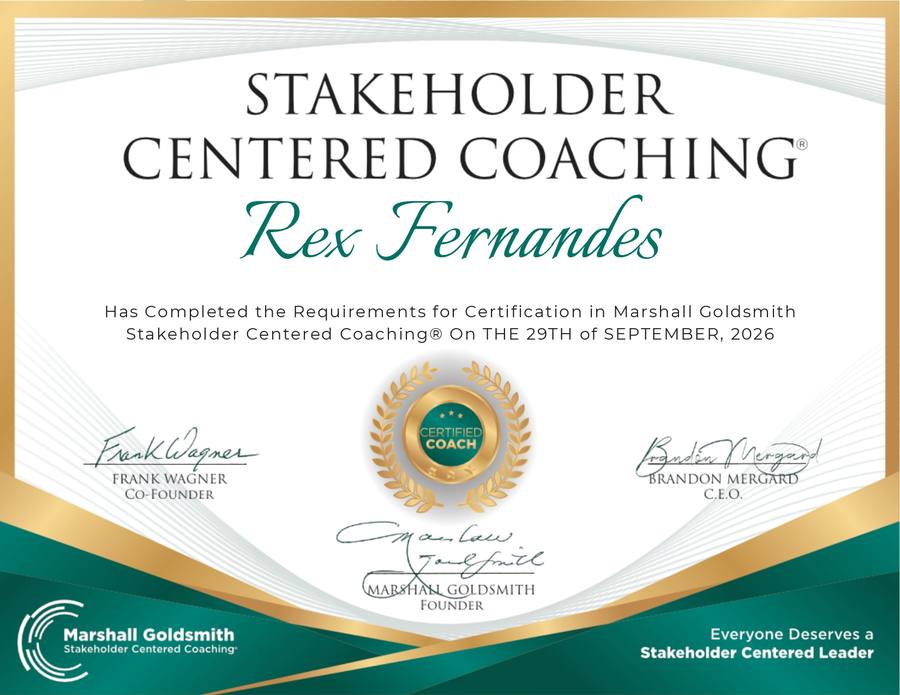
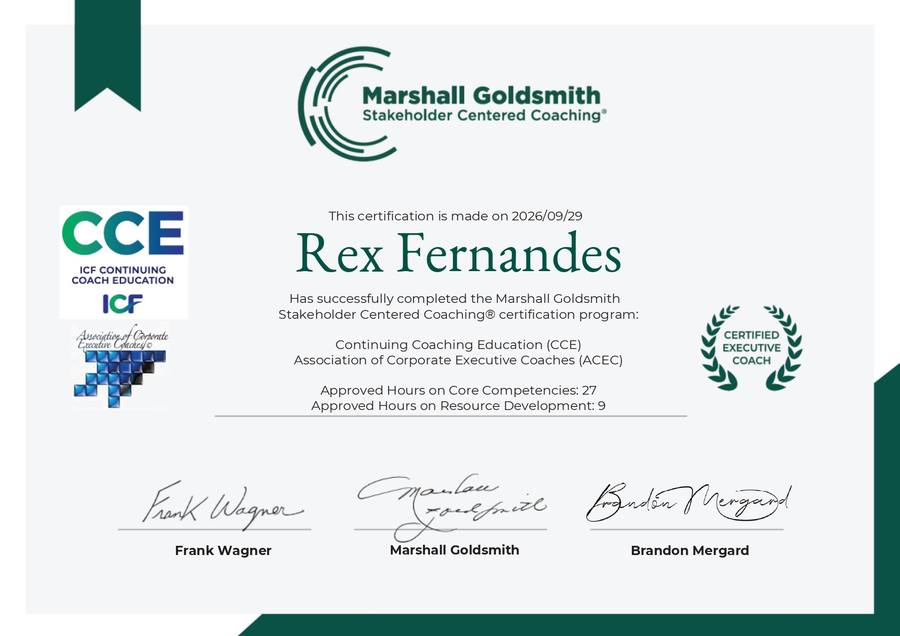
I am a certified practitioner of his method. I am not affiliated with Marshall Goldsmith personally, and nothing here should be read as a personal endorsement of my practice by him.


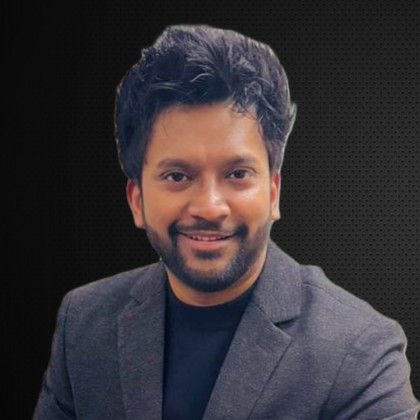
Fourteen years in leadership development, psychometric assessment and executive coaching. I am a Client Partner at Jombay, an AI-enabled talent assessment and leadership development company, and was previously Practice Director for its national leadership programmes HR40under40 and HR30under30.
I have designed and run assessment and development programmes for managers and senior leaders at Tata Motors, Bajaj Auto, SBI, Aditya Birla Group, Nasdaq and Kotak Mahindra Bank, and have facilitated workshops for more than 5,000 participants in person and online.
I have also built teams and departments from nothing and grown them into profitable units, so I have been on the other side of this. I trained as an engineer and began my career in machine learning research, which is probably why I am more interested in whether a leader actually changed than in whether the coaching felt good.


Stakeholder Centered Coaching does not work on everybody, and Goldsmith has been blunt about this for decades. He has written plainly about the people he will not take on, because coaching them wastes their time as well as his. I apply the same filter, which is what the first conversation is for.
The four disqualifying patterns are Goldsmith's own, set out in You Can't Coach the Uncoachables.
This is a working session rather than a sales call, and it is how the selection actually happens. You find out how I coach by being coached. I find out whether you are someone this method will work for. Roughly speaking, I expect to say no to a fair number of the people I speak to, and I will tell you why.
Bring something you are stuck on this week. A person, a decision, a conversation you have been putting off. We work on that, not on your career in general.
A specific thing to try before your next team meeting, and a way to tell whether it worked. Yours to keep regardless of what either of us decides.
I tell you whether I think coaching would help you, and whether I am the right person for it. Sometimes the honest answer is that you need a different intervention. You will get that answer rather than a proposal.
Send a message with your role, how long you have been managing, and the one thing you would want to work on. That last part matters, because it is most of what I am assessing. I reply to everyone personally, usually within a day.
Stakeholder Centered Coaching® and the Marshall Goldsmith Stakeholder Centered Coaching® marks belong to Marshall Goldsmith Stakeholder Centered Coaching. Rex Fernandes is a certified practitioner of the method and is not an employee, agent or representative of that organisation, and this page is not endorsed by Marshall Goldsmith.
Alongside one-to-one coaching I run the Rex Leadership Institute, which takes the same discipline into a different setting: operational and organisational leadership for pastors and church leaders across India. It has its own framework, The Mirror™, and its own assessment and practice tools. Different audience, same conviction that leadership is a set of behaviours you can measure rather than a quality you either have or do not.